


February 18, 2020
For decades, Uganda has provided asylum to people fleeing war and persecution in neighboring countries, particularly Burundi, the Democratic Republic of the Congo (DRC), Eritrea, Rwanda, Somalia, and South Sudan.
Situation
- As of January 2020, nearly 1.4 million refugees and asylum-seekers—including 867,000 South Sudanese and 403,000 Congolese—were sheltering in Uganda, which hosts the largest refugee population on the African continent. The displaced population in the country continues to grow, up from the approximately 1.2 million refugees and asylum-seekers registered as of January 2019.
- Many refugee households in Uganda rely on food assistance to meet their daily food needs. Without sustained assistance between February and May, refugees in Uganda would likely face Crisis (IPC 3) levels of acute food insecurity, according to the Famine Early Warning Systems Network (FEWS NET).*
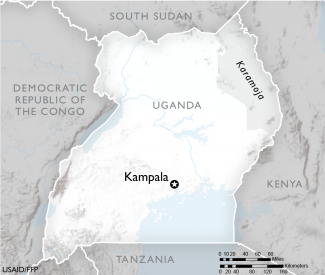
- Although Minimal (IPC 1) levels of acute food insecurity will persist across much of Uganda through May, heavy rainfall since October 2019 has resulted in flooding and landslides in some areas in eastern and western Uganda. The inundations have significantly disrupted agricultural and livelihoods activities, destroyed infrastructure and household goods, and undermined food security in affected areas. FEWS NET expects that many flood-affected households are facing Stressed (IPC 2) conditions. Additionally, Stressed levels of acute food insecurity are projected in northeastern Uganda’s Karamoja sub-region; FEWS NET reports that food security conditions in Karamoja may deteriorate if desert locusts migrate from neighboring countries and destroy crops and pastures in the coming months.
* The Integrated Food Security Phase Classification (IPC) is a standardized tool that aims to classify the severity and magnitude of food insecurity. The IPC scale, which is comparable across countries, ranges from Minimal—IPC 1—to Famine—IPC 5.
Response
- With funding from USAID’s Office of Food for Peace (FFP), the UN World Food Program (WFP) distributes locally and regionally procured emergency food assistance—such as beans, maize, and sorghum—to refugees and asylum-seekers in Uganda. Purchasing food locally and in neighboring countries enables FFP to rapidly deliver food assistance to populations in need while simultaneously strengthening regional economies. FFP also enables WFP to provide cash transfers for food to refugees in some areas, depending on local market conditions, empowering vulnerable people to purchase their choice of foods.
- In collaboration with Catholic Relief Services and Mercy Corps, FFP assists food-insecure Ugandans through multi-year development activities in Karamoja. FFP also partners with the AVSI Foundation to help extremely vulnerable refugee and Ugandan host-community households in southwestern Uganda’s Kamwenge District “graduate” from conditions of food insecurity and fragile livelihoods to self-reliance and resilience. Additionally, FFP partners with Save the Children and Innovations for Poverty Action to evaluate the graduation activity to ensure that FFP activities are impactful and cost-effective.
Food for Peace Contributions
Total Contributions:
| U.S. Dollars | Metric Tons | |
|---|---|---|
| Fiscal Year 2020 | $40.0 million | 45,810 MT |
| Fiscal Year 2019 | $94.5 million | 97,069 MT |
| Fiscal Year 2018 | $115.2 million | 152,288 MT |
* Metric tonnage does not reflect funding for vouchers or cash transfers.
Country Specific Guidance
Fiscal Year 2017 Uganda Graduation Pilot Country Specific Information
FEWS NET Uganda Staple Food Market Fundamentals January 2017
Related Resources
Image
Document