- Agriculture and Food Security
- Democracy, Human Rights and Governance
- Economic Growth and Trade
- Education
- Environment and Global Climate Change
- Gender Equality and Women's Empowerment
- Global Health
- Science, Technology and Innovation
- Water and Sanitation
- Working in Crises and Conflict

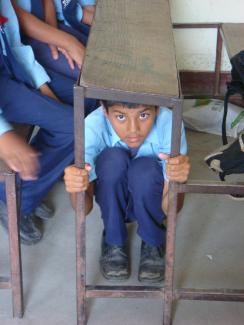
USAID responds to natural disasters around the world, protecting lives and livelihoods, and working to reduce the economic losses caused by these events. We also know that helping communities prepare for disasters, and working with them to lessen their exposure to hazards, can be extremely effective over the long term, saving both lives and resources.
USAID provides financial and technical support to many countries and communities working to reduce their risk to disasters, and ultimately strengthen the resilience of people to withstand adverse events.
Five Priorities for Action
- Making disaster risk reduction a priority.
- Improving risk information and early warning.
- Building a culture of safety and resilience.
- Reducing risks in key sectors.
- Strengthening preparedness for response.
Disaster risk reduction is a broad term that includes anything we do to prevent or reduce the damage caused by natural hazards like earthquakes, floods, droughts, and storms. A range of activities fall under the term, including creating early warning systems,improving data and information management capabilities, building capacity and training personnel for disaster response and management, improving building codes and practices, just to name a few.
USAID, like most of its counterparts in the humanitarian and development community, has been working under the 2005 Hyogo Framework for Action (HFA) to design its disaster risk reduction programs. The five ‘Priorities for Action’ were designed to promote progress and gain political support for disaster risk reduction on the international, national and local levels.
USAID has further developed a conceptual framework based on the HFA to better guide its disaster risk reduction programming in the years ahead.
This framework outlines the three broad areas USAID, through its Office of U.S. Foreign Disaster Assistance, works to reduce disaster risk:
- Prioritizing and strengthening early warning, preparedness, mitigation and prevention
- Integrating preparedness and mitigation with disaster response, early recovery, and transition to foster resilience
- Supporting diversified, resilient livelihood strategies
Prioritizing and strengthening early warning, preparedness, mitigation and prevention
USAID, through its Office of U.S. Foreign Disaster Assistance (USAID/OFDA), supports a variety of disaster risk reduction programs to prevent or minimize damage cause by disasters through early warning systems, disaster preparedness and mitigation efforts, as well as training for disaster response.
Many programs improve collection and use of data on disaster risks, including building capacity and infrastructure to observe, analyze, and forecast hazards. This may include mapping hazards, developing people-centered early warning systems, and facilitating exchange of information on risks. USAID/OFDA also supports the development of information-sharing systems and services, which may involve strengthening networks and promoting dialogue and cooperation among scientific communities and practition.
USAID/OFDA funds training and learning programs at a community level, for local authorities, and for targeted sectors. Preparedness for response addresses the need to plan for events where managing the risk proves too costly or not feasible. This area of programming directly links disaster risk reduction with disaster management and recovery. In this vein, USAID/OFDA works to strengthen policy; build technical and institutional capacities; support dialogue, information exchange, coordination and stakeholder engagement; stockpile commodities that may be needed in a response; and review and update disaster preparedness and contingency plans.
Last updated: May 17, 2013
@theOFDA
-
Cartoons and crisis preparedness? Read about the unique linkage here - t.co/lEfOLztJXa#Mahasen weakened lessening its impact on Bangladesh & Burma. Our staff is monitoring the situation and assessing humanitarian conditions.Please visit our new webpage for the latest info we have on #Mahasen. t.co/sPjoNcoUfP


Comment
Make a general inquiry or suggest an improvement.